Industry: Aviation / Airline Management
Role: Aerospace Performance Analyst
Context
Airlines operate on exceptionally thin margins, where ground-asset efficiency, hub logistics, and digital customer acquisition channels are the primary levers for long-term commercial profitability. This project focuses on optimizing premium airport real estate at London Heathrow (LHR) Terminal 3 and decoding global passenger booking signals.
Business Objective
The project addressed two core operational and commercial challenges:
- Hub Infrastructure Pressures: Forecasting premium lounge demand independently of rigid flight schedules to allow flexible fleet planning and capacity management.
- Revenue Leakage: Identifying high-yield browser segments and behavioral triggers to convert digital searches into flights and ancillary revenue before passengers embark on holidays.
Tools Used
Python (Google Colab) • PowerPoint
Key KPIs
Lounge Capacity Mix: Percentage distribution of Tier 1 (Concorde), Tier 2 (First), and Tier 3 (Club) eligible passengers segmented by flight profile to guide real estate scaling.
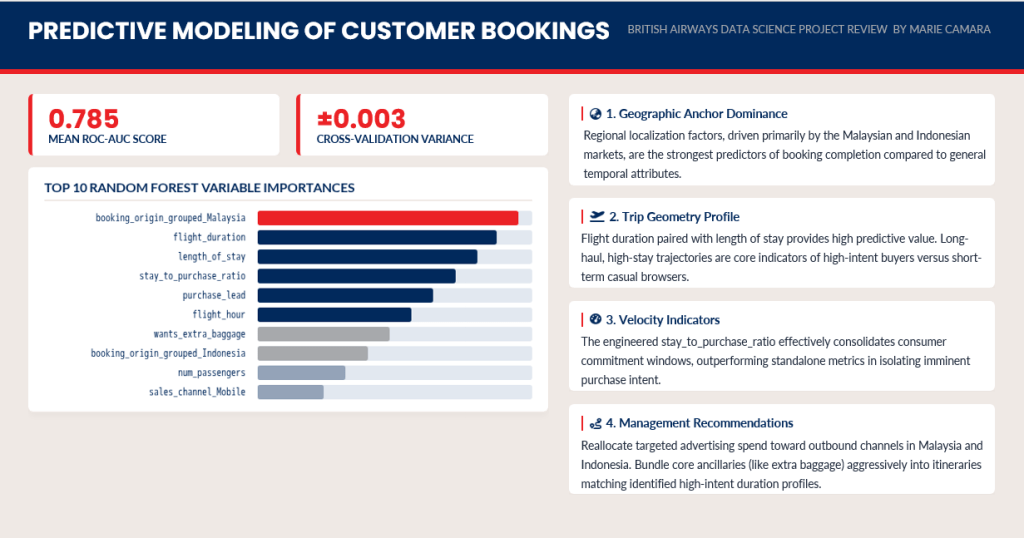
Predictive Accuracy (ROC-AUC): Achieving high discriminative power ($0.785 \pm 0.003$) to ensure mathematical stability in real-time customer search streams.
Conversion Probability Multiplier: Isolating regional markets (e.g., APAC paths) exhibiting up to a 4x higher purchase probability for targeted commercial actions.
Outcome
Dynamic Hub Planning Support: Delivered a reusable, aircraft-agnostic Hub Eligibility Matrix. The lookup table enables Airport Planning to seamlessly simulate fleet substitutions such as swapping a Boeing 787 for an Airbus A350 while maintaining accurate lounge capacity and demand forecasts.
Data-Driven Revenue Strategy: Identified the top booking drivers (led by Booking Origin, Flight Duration, and Stay-to-Purchase Ratio). This provides direct decision support to prioritize digital marketing budgets toward high-intent paths (Malaysia and Indonesia) and to natively bundle ancillary offerings, such as extra baggage, into long-stay itineraries.
 Marie Camara